Side-Hung vs. Pivot Kinematics: Load Path and Structural Mechanics
The core engineering distinction between traditional side-mounted hinges and a weldable pivot hinge assembly lies in how primary gravitational and dynamic forces transfer into surrounding civil or structural steel framing.
In side-hung installations, hinges are mounted along the vertical jamb. Because the door mass center of gravity is offset horizontally from the rotational axis, the door acts as a cantilever beam. This configuration creates high horizontal reaction forces: an upper radial tension couple pulling the top hinge away from the jamb, and a lower radial compression couple pushing the bottom hinge into the jamb. When doors are exceptionally wide or heavy, these cantilever forces can distort the vertical jamb post, induce localized structural deflection, and cause rotational binding.
For engineers evaluating traditional side-hung installations and sizing moment arms on vertical jambs, review our reference on Weld-On Hinge Load Capacity and Spacing Calculation.
By contrast, a top-and-bottom weldable pivot hinge relocates the rotational axis to the top and bottom horizontal planes of the door leaf:
- Direct Axial Load Transfer: The entire gravitational dead weight of the door transfers axially down through the bottom pivot assembly directly into the floor sill, footing, or structural base beam. The vertical jambs carry zero dead weight load.
- Elimination of Jamb Overturning Moments: Because horizontal reaction forces are absorbed between the upper header beam and the solid floor sill, the vertical side jambs are relieved of cantilever bending moments, preventing jamb bow and frame distortion.
- Reduced Operational Friction: Concentrating vertical dead weight onto a dedicated axial thrust bearing significantly lowers manual opening torque compared to distributing mass across multiple side-mounted hinge barrels.
To place pivot assemblies within the broader landscape of mechanical door joints, consult our foundational hub guide on Industrial Hinged Joints and Connection Types.
How does a weldable pivot hinge change the structural load path compared to side-mounted hinges?
A weldable pivot hinge redirects the door gravitational dead weight straight down into the floor or foundation sill through a bottom axial thrust bearing, rather than hanging the mass off the vertical jamb post. This eliminates the horizontal cantilever overturning moment on the vertical jamb, preventing jamb deflection on wide, heavy doors and distributing reaction forces between the upper structural header and lower sill.
Center-Hung vs. Offset Pivot Geometry: Clearances and Swing Dynamics
Weldable pivot hinges are categorized into two primary geometric configurations based on where the vertical rotational centerline is positioned relative to the door leaf thickness:
Comparison table Scroll horizontally →
| Pivot Configuration | Rotational Centerline Location | Door Swing Kinematics | Primary Application Suitability |
|---|---|---|---|
| Center-Hung Pivot Assembly | Located directly along the central thickness plane of the door leaf, inset from the heel edge | Allows single-acting or true double-acting (bi-directional swing); completely concealed hardware when closed | Symmetrical architectural doors, heavy double-swing industrial airlocks, security turnstiles, and balanced portal closures |
| Offset Pivot Assembly | Located forward and outward from the face and heel edge of the door leaf | Permits single-acting swing; swings door leaf entirely clear of the opening throat to maximize access clearance | Acoustic-sealed doors, radiation shielding barriers, thermal gasketed enclosures, and deep-frame industrial access portals |
Center-hung pivot geometry provides clean aesthetics and balanced weight distribution. However, because the heel edge of the door swings inward as the main leaf swings outward, the vertical heel edge must be radiused or given adequate clearance against the jamb to prevent mechanical interference. Additionally, continuous perimeter weatherstripping or acoustic sealing requires specialized rebate profiles.
Offset pivot geometry moves the pivot axis outward, functioning similarly to an oversized butt hinge while retaining floor-supported weight transfer. This outward offset allows the door leaf to swing clear of the opening throat without heel-edge pinch points, making it compatible with continuous perimeter compression gaskets and perimeter frame stops.
What mechanical factors determine whether to use center-hung or offset pivot geometry?
Center-hung geometry is chosen when double-acting swing, concealed hardware aesthetics, or balanced center-of-mass rotation is required, provided the door heel edge can be radiused to prevent jamb binding. Offset pivot geometry is selected when the opening requires continuous perimeter compression gasketing, deep frame stops, or clear-throat opening width where the door panel must swing completely outside the frame line.
Heavy-Duty Bottom Pivot Assemblies: Thrust Bearings and Axial Support
The bottom pivot assembly serves as the primary load-bearing foundation of the entire installation. Because it carries the total vertical mass of the door plus dynamic vertical acceleration loads, the internal bearing interface dictates rotational smoothness and service longevity.
Depending on environmental conditions and operating frequency, fabricators utilize several internal bearing arrangements:
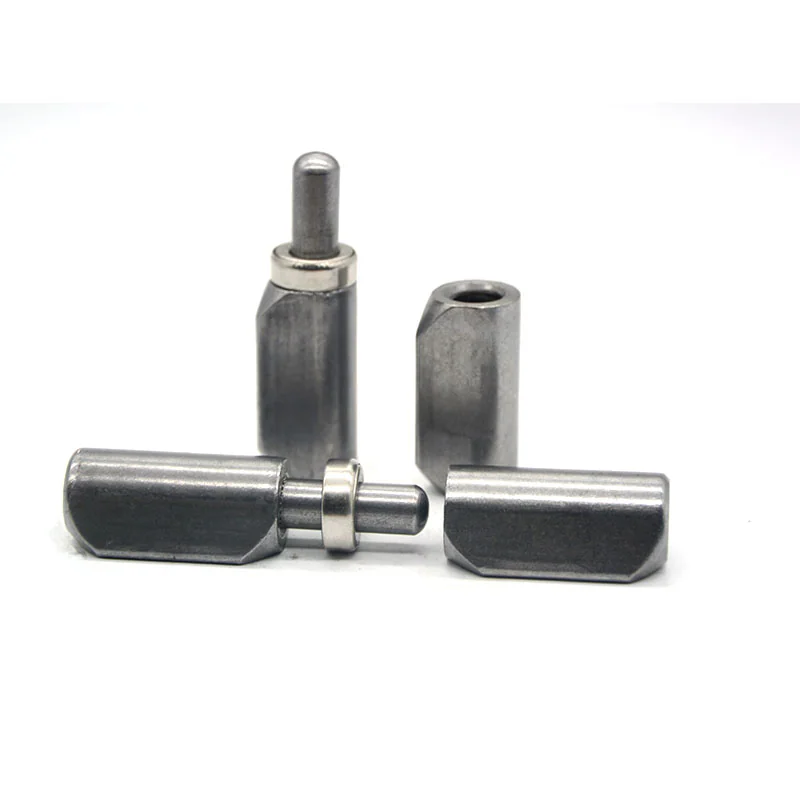
- Hardened Roller Thrust Bearings: Heavy-duty cylindrical or tapered roller thrust assemblies provide maximum dynamic load ratings and exceptionally low rolling friction. They are standard in heavy industrial gates, security portals, and motorized swing closures.
- Spherical Self-Aligning Thrust Washers: Sintered bronze or hardened alloy spherical washers allow slight angular misalignment between the floor plate and door bottom without edge-loading the bearing pack, preventing localized point-contact binding.
- Solid Sintered Bronze Bushing Interfaces: Maintenance-free self-lubricating bronze sleeves impregnated with oil or solid graphite plugs, suited for caustic, high-moisture, or washdown environments where rolling-element bearings are vulnerable to contamination.
For detailed material compatibility rules and bearing selection criteria across various industrial atmospheres, consult our guide on Bearing, Pin, and Washer Selection for Weld-On Hinges.
Because bottom pivot assemblies sit at floor level where dirt, grit, moisture, and washdown chemicals accumulate, environmental sealing is paramount. Bottom pivot housings should incorporate labyrinth seals, elastomeric O-rings, and accessible grease zerk fittings to allow periodic contaminant purging. For lubrication maintenance design rules, reference our guide on Grease Fitting and Lubrication Design for Weld-On Hinges.
How should the bottom pivot bearing be protected against contamination and premature wear?
Bottom pivot bearing packs should be housed in enclosed, sealed steel sockets equipped with internal grease cavities, elastomeric lip seals or O-rings, and external grease zerk fittings. Regular grease injection purges moisture, particulate grit, and chemical washdown residue out of the bearing raceways, while spherical seating washers prevent edge-loading caused by minor floor installation misalignments.
Top Pivot Design: Radial Guide Alignment and Thermal Float Relief
While the bottom pivot carries axial gravity weight, the top pivot functions strictly as a radial alignment guide. Its mechanical role is to stabilize the upper end of the door leaf against horizontal wind loads, door momentum, and dynamic lateral forces while permitting smooth rotation around the shared vertical axis.
Critical design considerations for top pivot assemblies include:
- Vertical Thermal Float Relief: In exterior industrial environments, large steel door leaves expand and contract vertically with seasonal ambient temperature swings. The top pivot pin and socket must feature sufficient vertical slip engagement (axial clearance) so that vertical door expansion does not exert compressive axial loads onto the top pivot or structural header beam.
- Retractable or Removable Pin Mechanisms: To install or remove heavy doors without lifting the entire leaf over an extended fixed pin, top pivots frequently incorporate retractable pins operated via an access screw, or removable walking-beam pin assemblies.
- Coaxial True Centerline Alignment: The rotational axis of the top pivot pin must be aligned perfectly plumb with the bottom pivot bearing center. Angular misalignment between top and bottom axes causes severe pin binding, high rotational torque, and premature bushing ovalization.
For detailed alignment verification techniques and mandrel-based setup procedures, review our technical guide on Weld-On Hinge Alignment and Removal Clearance.
Why must the top pivot assembly incorporate vertical axial float?
The top pivot must incorporate vertical axial float to accommodate thermal expansion and structural frame settling without binding. If the top pin is rigidly captured in the vertical direction, thermal expansion of a tall steel door panel will drive high axial compressive forces into the upper header beam and overload the pivot assembly. Axial slip allows the pin to glide freely within its sleeve while maintaining rigid radial guidance.
Fabricating Weld-In Pivot Mounts: Structural Header, Sill, and Barrel Profiles
In custom steel door fabrication, pivot assemblies are integrated directly into structural door rails and building frames using heavy-duty weldable barrel profiles and reinforcement plates.
Selecting between hinge barrel body geometries depends on the mating structural steel section:
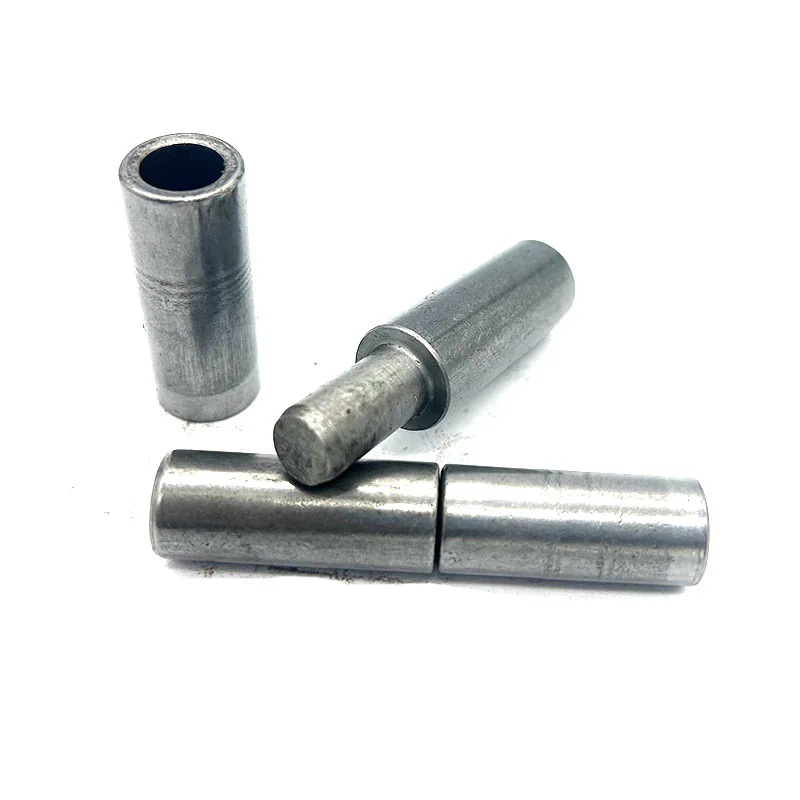
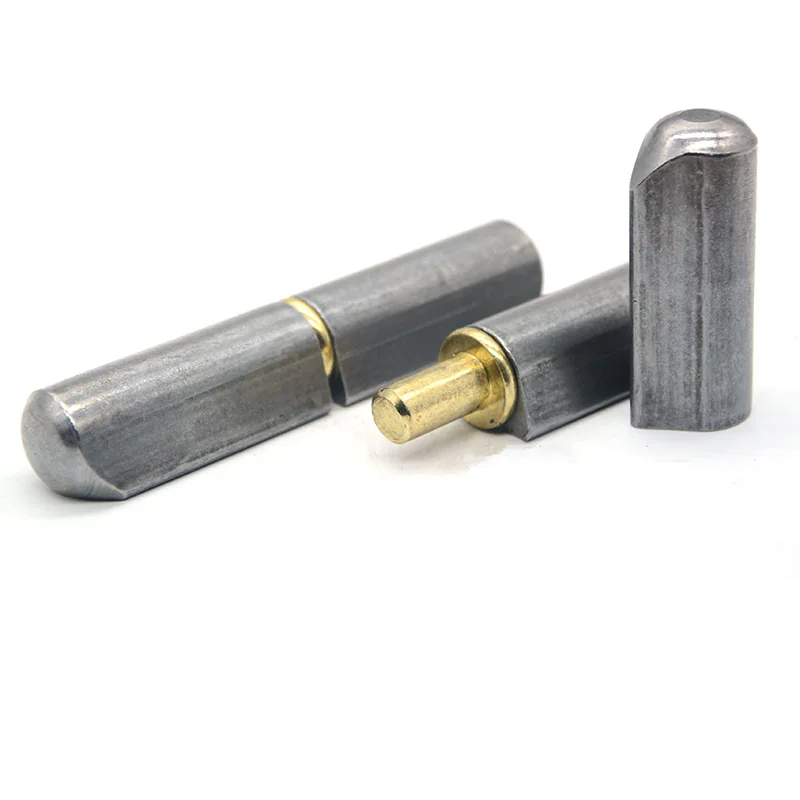
- Cylindrical Round Barrel Housings: Symmetrical round barrel bodies weld cleanly into radius corners of square or rectangular structural tubing, heavy structural channel headers, and embedded floor socket weldments. Symmetrical geometry simplifies boring, lathe turning, and concentric jigging during fabrication.
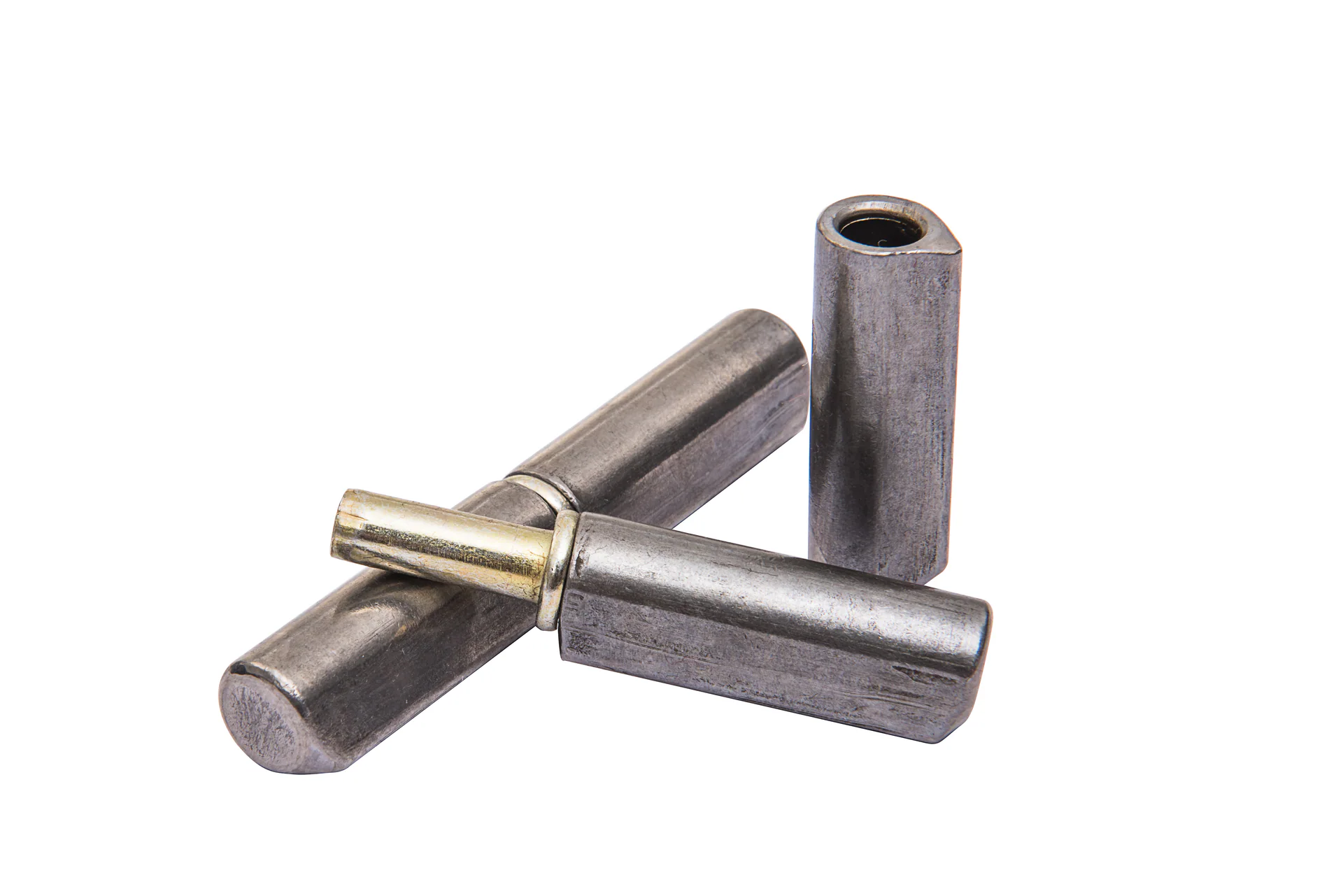
- Teardrop (Water-Drop) Profile Housings: Feature an extruded welding flange extending outward from the cylindrical body. This profile provides natural standoff clearance when welding pivot brackets along formed sheet metal doors, narrow door return flanges, or unreinforced panel edges where the welding lip prevents arc heat from distorting internal pin bores.
Both cylindrical and teardrop profiles serve complementary roles depending on whether the pivot housing attaches to heavy structural tubing or formed sheet steel framing. For detailed dimensional standards across barrel configurations, consult our guide on Weld-On Hinge Sizes and Dimensional Standards. For distortion prevention on thin-gauge door skins, reference Welding Hinges to Sheet Metal Doors.
When evaluating standard weldable barrel components against fully custom machined pivot blocks, consult our engineering guide on Standard vs. Custom Weld-On Hinges.
Application Decision Matrix: When to Select Pivot over Side-Hung Hinges
Choosing between side-mounted barrel hinges and top-and-bottom weldable pivot hinges requires analyzing structural framing stiffness, door aspect ratios, environmental sealing, and site installation constraints.
Comparison table Scroll horizontally →
| Design Parameter | Side-Mounted Weld-On Barrel Hinges | Top and Bottom Weldable Pivot Hinges |
|---|---|---|
| Primary Load Path | Loads transfer into vertical jamb posts as combined axial weight and horizontal cantilever moments | Axial weight transfers directly into floor sill; upper radial forces transfer into overhead header beam |
| Door Aspect Ratio Suitability | Optimal for standard height-to-width ratios where vertical hinge spacing creates an effective moment arm | Optimal for wide, oversized, or extremely heavy doors where cantilever moment would overload side jambs |
| Jamb Structural Requirements | Requires rigid vertical structural steel jamb columns to resist horizontal pull-out and bending | Requires minimal vertical jamb strength; requires robust floor sill foundation and overhead header beam |
| Swing Direction Versatility | Single-acting swing (outward or inward only); swing path defined by jamb face | Single-acting or true double-acting (bi-directional center-hung swing); full continuous rotation capable |
| Gasket & Weatherstrip Sealing | Straightforward continuous perimeter compression sealing against vertical jamb stops | Center-hung requires specialized radiused seals; offset pivot supports standard perimeter compression seals |
For standard industrial enclosures, trailer bodies, and perimeter swing gates where vertical jambs provide rigid support, side-mounted weld-on hinges remain the standard mechanical solution. For foundational advice on general hinge selection criteria, explore How to Choose Weld-On Hinges and our overview of Weld-On Hinges for Gates, Trailer Doors, and Ramps. For electrical cabinet applications, review Weld-On Hinges for Machine Enclosures.
When should design engineers transition from side-hung hinges to a top-and-bottom pivot assembly?
Design engineers should transition to a top-and-bottom pivot assembly when door panel width or mass creates excessive cantilever moments that cause vertical jamb deflection, when bi-directional double-acting swing is required, or when architectural aesthetics demand balanced center-hung rotation where all rotational hardware is concealed along horizontal header and sill lines.
Engineering Drawing Callouts and Custom Pivot Specification
Specifying weldable pivot components on production fabrication drawings requires unambiguous callouts covering material chemistry, bearing types, concentricity tolerances, and post-weld machining operations.
For material pairing rules and corrosion mitigation strategies across stainless steel and carbon steel fabrication, review our guide on Weld-On Hinge Materials and Finishes. To structure your CAD submittal package for custom manufacturing quotes, consult our guide on Preparing Hinge Drawing Dimension Requests.